Consequently, human intelligence is insufficient to narrate the generation of Mary. Let us therefore invoke the grace of the Holy Spirit, that grace by which Mary was sanctified, and let us pray to the divine Spirit that I may have something to say.
(St. Thomas Aquinas, Germinet Terra)
St. Thomas Aquinas is known as one of the greatest — if not the greatest — theologians and philosophers in history, the doctor communis of the Church: a well-deserved honour. However, there is an equally important aspect of this teacher that often goes unnoticed: that of a preacher.
As a Master of Theology, in addition to commenting on Sacred Scripture and disputing theological questions, part of his job was to preach1. In this manner, during the Middle Ages, the study and teaching of theology had a natural pastoral and evangelical outlet2, and the medieval teacher could never live detached from the Church’s greatest challenge from its beginning, that of evangelization3. Furthermore, St. Thomas was a Dominican, that is, a friar preacher: this task, therefore, had for him an even greater importance, one that derives from the very nature of his vocation.
Unfortunately, not many of his sermons have come down to us. Among those that we do have, however, there are two that concern today’s feast of the Nativity of the Blessed Virgin Mary: Lux orta est — divided between a morning sermon and an evening lecture — , and Germinet Terra — held during the octave of the Nativity, and the eve of the Exaltation of the Cross; thus we have a morning sermon on Our Lady, and an evening lecture on the Cross. In the first sermon, Thomas takes as his starting point a verse from Psalm 96: “Light is risen to the just, and joy to the righteous of heart.” (Ps 96:11).
First of all, Thomas shows how the birth of Mary was prefigured in the Old Testament in different ways. For example, her contemplation is prefigured by the springing up of a sprout from a root: just as a sprout, when it emerges from the earth, is immediately directed towards the skies, so the Blessed Virgin “transcended present earthly realities, and had her heart elevated towards heavenly realities4.”
The rest of the morning sermon plays on a comparison between our Blessed Mother and the light. In the first place, her relationship with her Divine Son is emphasized: Mary is light because from her comes Jesus, the light of the world (Jn 8:12). Then, in a passage in which Thomas is unable to hide his tender affection for the Mother of Christ — an affection worthy of a friar belonging to an Order which, according to tradition, was born thanks Our Lady’s prayers5 — these comparisons multiply into a litany of praise:
We note the fact that corporeal light is the origin of joy, is the guide of travelers and pilgrims, drives out darkness, diffuses itself, is the mother of heavenly graces, is the most beautiful of creatures, is pleasure and consolation for the eyes. All this is found in the Blessed Virgin.6
Our Lord says: “Walk while you have the light, so that the darkness does not overcome you.” (Jn 12, 35) For Thomas, this light is Mary, who is ‘the guide of travelers.’ We must therefore walk with this light in order to avoid the works of darkness7. Moreover, she is “the way of the just that proceeds like the light ‘(Pr 4:18), that is, she is the way we must follow, because ‘she is straight and direct for the righteousness of her life8.”
Like the light that chases away the darkness, with the presence of Mary the darkness of vice flees, introducing the light of grace, a light that is diffused to all9. If in the morning Thomas focused on honouring the Blessed Virgin, in the evening he takes an exhortative turn. 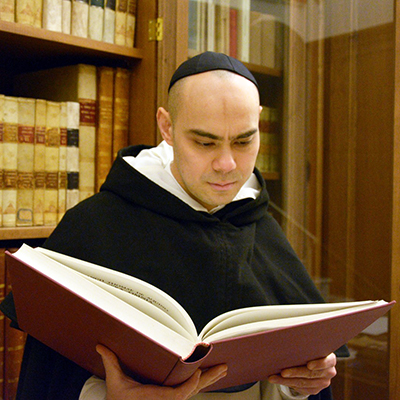 br. Jean-Gabriel Pophillat, O.P.For, in the verse of the Psalm cited, we read that this light has risen for “the righteous of heart”: Our Lady’s light gives joy, but only to the “righteous of heart”, while this light is distressing for the wicked10. Thus, if we are to share in the joy of this feast, we need to understand who the “righteous of heart” are, and try to imitate them. To be righteous, man must first possess an interior righteousness, that is, in his intellect and in his affections.
How can a man be righteous in his intellect? Our intellect was created to know the truth: therefore, its righteousness comes from the truth. The Supreme Truth, however, is God himself, who is beyond our capacities. We thus have need of the gift of faith, which is “the spiritual light that permits us to know God and divine things”. Faith allows us a certain knowledge of the Supreme Truth, and it is this knowledge that makes us righteous in our intellect11.
I add that this knowledge, although still imperfect, is nevertheless a foretaste of heaven, as St. Paul tells us: “Now we see as in a mirror, in a confused way; but then we will see face to face.” (1 Cor 13:12) For this reason, Thomas describes faith as the virtue that begins the blessed life in us12. We can then understand Elizabeth’s words when speaking of Our Lady: Blessed is she who believed (Lk 1:45). Mary’s blessedness and happiness derive from her faith: we too can have this happiness, if we imitate her in her faith!
How can a man be righteous in his affections? When his will is conformed to the divine will13. Once again, we find in Mary the exemplar of this righteousness: it is she who, to the words of the angel Gabriel, replied without delay: “Let it be done to me according to your word;” (Lk 1:38) moreover, it is she who, at the wedding at Cana, asked us to “do whatever he tells you.” (Jn 2:5) For this reason, in the sermon Germinet Terra, St. Thomas says that in the Gospels the Blessed Virgin teaches especially obedience14.’ But Mary’s was not a blind and mechanical obedience, nor an obedience due to the simple fear of some divine punishment. Mary’s obedience was perfect, because it is derived from love. For Thomas, charity produces a union of affections: the other is loved as himself, and one wants what the other wants as if it were his own desire15. Therefore, to have righteousness of affection, we need the gift of charity, which unites us to God, conforming us to his will16. And if the intellect was created to know the truth, the will was made to do good: knowing God, the intellect finds its fulfillment; by doing his will, the will finds its fulfillment. United with God, the Supreme Good, man finds his fulfillment and happiness.
Righteousness of intellect and affection then leads to an exterior righteousness. Thomas says: “When there is righteousness in the inner man, then there is righteousness in the outer man.” According to St.Thomas, body and soul enjoy an intimate unity: a man who possesses faith and charity in his interior will try to live and act righteously: in his gaze, in his speech, even in his walking17.
At the end of his lecture, Thomas shows us what the upright in heart actually do: they correct their lives through penance, love God, and give thanks to Him18. Can we not take this as advice for us? If Mary is the mother of all Christians, then today is truly the birthday of our Mother. To celebrate it fully, and to enjoy that joyful light which is Our Lady, let us strive to be upright in heart. If we have not been loving God and neighbor as we should, this is the time to change. Let us learn to love Him, and finally, celebrating this feast day, we can give thanks to Him for this great gift which is Mary.
Praised be Jesus and Mary!
br. Jean-Gabriel Pophillat, O.P.
—————————————————–
1. cfr. Peter the Cantor, Verbum adbreviatum 1, in J. P. Torrell, Amico della Verità: Vita ed Opere di Tommaso d’Aquino, Edizioni Studio Domenicano, 2017, p. 128.
2. cfr. C Pandolfi, Introduzione Generale, in Tommaso d’Aquino, I Sermoni e Le Due Lezioni Inaugurali, C. Pandolfi e G. M. Carbone (a cura di), Edizioni Studio Domenicani 2003, p. 10.
3. John Paul II, Veritatis Splendor, n. 106.
4. Lux orta est, rr. 66-72. (lines numbers are from Thomas De Aquino, Sermones, Opera omnia iussu Leonis XIII P.M. edita, tom. XLIV-1, Roma 2014, pp.263-277. Translation is mine)
5. cfr. Geraldo di Frachet, Vitae fratrum, P. Lippini (edited by) Edizioni Studio Domenicano 1988, p. 18.
6. Lux orta est, rr. 120-126.
7. Lux orta est, rr. 144-154.
8. ibid., rr. 155-161.
9. ibid., rr. 167-179.
10. ibid. rr. 237-244.
11. ibid. rr. 285-297
12. Summa Theologiae, II-II, q. 4, a. 1.
13. Lux orta est, rr. 298-304.
14. Thomas De Aquino, Sermones, Opera omnia iussu Leonis XIII P.M. edita, tom. XLIV-1, Roma 2014, p. 284.
15. Summa Theologiae, II-II, q. 29 a. 3.
16. Lux orta est, rr. 298-304.
17. ibid. rr. 305-399.
18. ibid. rr. 400-419.